

Well, I waited almost three months to do it, but there it is -- our Official Dorky Travel Writing Heading. Whaddyathink, am I ready for "Sunset?"
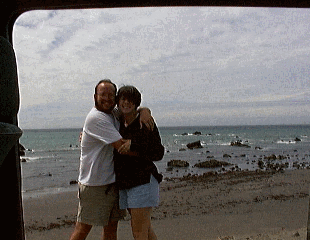
We really did find the Lost Coast, though. As I mentioned in yesterday's episode, the Lost Coast is the area of the California coastline where Highway 1 juts abruptly inland, leaving the coast to fend for itself without RVs, chainsaw art emporiums, and anything with the word "burl" in it. How they manage, I do not know. The single-lane road that took us out to the coast wended precipitously over mountains and past washouts, giving us more than one scare. We made it, though, passing through the tiny burgs of Honeydew and Petrolia before meeting up with the sea at the mouth of the Mattole River. For those of you who like to fish for steelhead in the winter and have access to Northern California (all two of you), the Mattole River is a bit of an untouched gem, owing mainly to its remoteness. Call ahead, though -- low water problems have forced unscheduled closures in recent years. This has been Two-Salt Sid's Angling Report.
Once you get out to the Lost Coast, you're in for a real treat. There just really isn't anyone else there. The road parallels the beach for about seven miles, but you can hike much further in either direction, if that's what your heart desires. Eventually, the road returns to the mountains, dropping you into the quaint little Victorian town of Ferndale. They've got all the things that quaint little Victorian towns usually have -- antique shops, B&B's, galleries, and a rogue sheriff named "Bone" who rules with an iron fist, but moonlights as a leather-lunged blues-howler in local watering holes. Come to think of it, old Bone might be pretty specific to Ferndale.
Ferndale was nice, but we didn't need any doilies or anything, so we headed out to Humboldt. We found a nice nature preserve and parked Otto so I could do a couple hours worth of work. After a short Kinko's stop in Eureka, we were back on the road to Crescent City, and then Redwood State Park. That's where we found the Smith River.
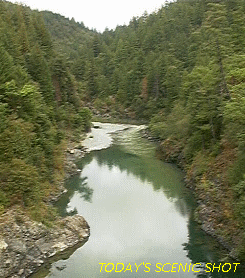
And what a river it was! Cutting a violent swath through igneous rock, the Smith tumbled mightily down its canyon. The Smith's waters were incredibly clear, revealing the streambed with amazing clarity. You could see every rock, every pebble. With its cold, clean water and gravel beds, the Smith was as classic an anadromous stream as I've ever seen -- perfect spawning habitat for ocean-going fish such as salmon, steelhead, and sea-run cutthroat, but entirely too sterile to support much of a year-round resident population of trout. Still, it was lovely, and we thoroughly enjoyed the drive up the canyon to our campground.
We ended up camping at the Patrick Creek campground on the Smith River, built in 1926 by the Conservation Corps. This campground had the singular advantage of being right across the street from the Patrick Creek Resort, Lodge, and Lounge. So, after a filling dinner of split-pea and ham soup (my grandma would be so proud!), we repaired to the lounge across the street for some real primitive-style camping. Yeah, cheesecake and hefeweizen...do we know how to rough it, or what?
As we headed back to Otto, a light rain began to fall. We fell asleep to the sound of rain tip-tapping off Otto's fiberglass roof, one of my favorite sounds around. Check back tomorrow, as we head up into Oregon, the last state we'll hit that we haven't yet been to on the Odyssey. See you then!
Total Miles for 8/25 = 199